
Stories of some who have escaped the war and still fight for its end
Authors: Rubens Antunes, Liz Barros, Sofia Finamore
The Vietnam War started with the objective to unify North Vietnam and the south, both fighting for the unification of the country under government supervision. It counted with the participation of the United States, which was on the side of South Vietnam. During the War (1955-1975), around 966.000 to 3 million soldiers and civilians were killed, and those who survived were left with sequelae and disorders. It was a very cruel war and the United States of America ended up being the country named as the “loser” of the war.
Throughout the war, many American soldiers got involved and had children with Vietnamese women who, by the end of the war, became orphans in Vietnam.The Vietnamese culture of the time considered it “better to marry a dog than to have children with a foreigner,” which led the mothers to abandon their children, because they were ashamed of them, and making those children orphans of both parents
Considering the data collected by Ohio University, 25 thousand Asian Americans entered the USA after the war period, many of them with traumas. 76% had the objective to find their family, but only 30% knew their names. Only 3% of those were able to find their family and only one third of them were received in homes, since many of the soldiers who had children in Vietnam married American women and started new families. In addition to these people having to accept the fact that they may never really know their family, they suffered xenophobia (among other problems) just for being Asian American with vietnamese ancestry, and most of them had to deal with all that since they were young.
The USA government has already tried to solve the orphans problem. In April 1975, the government started an operation to repatriate those orphans using airplanes and helicopters. As a result, they saved more than 3,000 kids, but they lost hundreds of them when the aircraft C5A Galaxy fell with 400 kids and 60 volunteers and only 160 people survived.
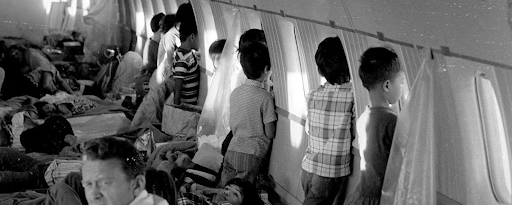
At the same time that the operation was very successful in many aspects, it also caused enough horror for children to traumatize them. Many of these traumas were developed due to, for example, the helicopter sound. This operation became so poignant that authors have included it in recent books. In the book Broken Pieces, by Ann E. Burg, it is possible to see that, when the protagonist gets out of Vietnam, by helicopters and planes, the aircraft sounds leave some kids terrified, and even trigger panic attacks.
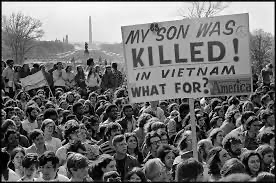
During all of these operations in Vietnam, the President John F. Kennedy acted for the indirect participation of the country in the war but, when he died, the new president Lyndon Johnson decided to intervene in the war, causing protests. These protests were open to anyone who wanted to participate, acting mostly against the war, racism, nuclear guns and in favor of women’s rights. This popular pressure of the war in Vietnam and the revolts occuring in the USA led the United States President Richard Nixon to propose a ceasefire with North Vietnamese troops, in 1973.
The book She Loves You, by Ann Hood, shows how music intervened in people’s lives during this difficult time, using it to escape from the war problems, through the point of view of a twelve-year-old girl called Trudy who lived in 1966 during the war. Her life was good until the war, then everything changed, and what really helped her deal with that difficult moment was precisely the music, more specifically the band The Beatles, that were really famous at the time.The band was really important for Trudy, helping her to distract herself and feel comfortable in her country during the hard times of her life by listening to music.
Trudy didn’t participate directly in the war, she did not fight on battlefields to really be considered a participant in that conflict but, even so, her life was impacted by the Vietnam War. Trudy lived part of her adolescence seeing the protests and revolts happen and having to deal with the conflicts in the school caused by the opinion and disagreement of the students in relation to the war.
Differently from Trudy’s story, the main character of the book Broken Pieces by Aan E. Burg worked directly in the conflict. In this book, readers follow a story of immigrants during the time of the war, and the relationships with their adoptive families, showing how some of the American people still mind Asian culture and how they welcomed the war orphans. The main character was an immigrant and suffered xenophobia for being Asian when he started living in the USA. He also suffered during the war, with the loss of his dad.
Like immigrants, soldiers at that time dealt directly with the war. The options at that time regarding military forces were voluntary or compulsory enlistment. these soldiers had to face this period of suffering whether they wanted to or not, and periods of war, especially for those who have lived it directly, became frightening and traumatizing, affecting the lives of many long-term.
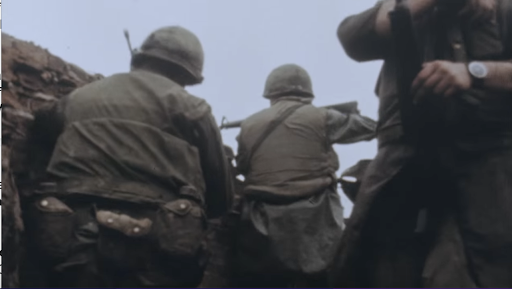
The book Cracker! The best dog in Vietnam, by Cynthia Kadohata, shows the life of soldiers during the war, indicating the reader to perceive and understand different perspectives, fears, motivations and expectations of the people who were in that environment to defend their homeland, not only including the reality that soldiers dealt directly with the war by fighting in the conflicts , and also internally with the “fight” inside their minds. In addition, the book also shows the participation of dogs trained by the army to fight in battlefields, and the bond that soldiers develop with these animals during the war. The story specifically focuses on a female dog named Cracker, the soldier Rick Hanski, who she learns to live with amidst the chaos of war, and their relationship.
When Rick asked his family if he could sign up to become a soldier and fight in the Vietnam War, his grandfather’s expression turned grim. His grandfather (who had lived in Finland during World War II) described it as “an ugly thing,” “a horrible period of pain and suffering,” “a conflict that, no matter how many years pass, is still stuck in the mind of those who dealt with it. “For many of the US veterans who served in Vietnam, the psychological nightmare rages 40 years after the last Marine left Saigon. Psychological research suggests that as many as 271,000 war veterans may still have full-blown post-traumatic stress disorder, or PTSD. And for many vets, PTSD symptoms are only getting worse over time. “About 11% of Vietnam veterans over a 40-year period continue to suffer from clinically important PTSD symptoms, having either a full diagnosis or very strong diagnostic features that interfere with function,” says Charles Marmar, director of The Steven & Alexandra Cohen Veterans Center at NYU Langone Medical Center.
An interview conducted by Butsarakham Dyer, made questions to D.R.D: a veteran who fought in the Vietnam War and who preferred to have his identity withheld during the interview. The same said, in response to the question about his perceptions before and during the war: “Before, I was curious in a good but horrible way. Neither side could afford to lose a war. And so, I, who was previously interested academically and intellectually in the war, was horrified by what I saw happening. Without clear foreign policy goals, many battles were just people wandering in the mountains or jungles of Vietnam. And the body count was worth the metric. It was extremely common to receive questions like: How many Americans were killed this week? How many South Vietnamese were killed this weekend? How many North Vietnamese were killed this week? “
In addition to D.R.D’s claims of how horrible the war was and how many traumas and injuries he carries to this day, he says with conviction: “I don’t want to… I’m glad my son never left home for the purpose of being part of a draft. military, participate in a war. Well, I don’t want my grandson to go. I don’t want anyone else to go,” about his reaction to his son wanting to follow in the same footsteps as him.
In short, we can see that, in the midst of a war, different people deal with the conflict in different ways. Some try to find a mental refuge to forget the problems that surround them, such as the character Trudy, from the book She Loves You by Ann Hood, who, in the midst of the chaos of her country during the war, finds a mental escape in music. Otherswho deal more directly with war and want to escape that reality, such as immigrants, seek physical refuge elsewhere, in a place that is safe and free of fear, as in the book Broken Pieces by Aan E. Burg. There are also those who deal directly with the war out of obligation, like soldiers, who do not seek refuge, but a motivation to continue fighting without losing strength and to remain firm in that position, just like in the book named Cracker! The best dog in Vietnam by Cynthia Kohata.
War, one way or another, ends up affecting all people, in different or similar ways. As it is a difficult and frightening period, the war ends up triggering fears and psychological disorders even years later. Trying to have a refuge, whether mental or physical, is often not enough to preserve the human mind from the horrors that happen in a period of battle, and that makes us think: even if some people are part of the nation that emerged victorious from the Vietnam War, is victory equal to have sound mental health?