The books Cracker! The Best Dog in Vietnam and The Night Spies by Cynthia Kadohata and Kathy Kacer are stories that are part of the literary genre historical fiction and have children and pre-teens as their target audience. The first mentioned book tells a story about a relationship of trust and friendship between a newly recruited American soldier and an army dog during the Vietnam War period, while Kathy Kacer’s book is an holocaust remembrance that tells about a jewish family who, thanks to prejudice and religious intolerance against Jews, are forced to hide in a small village in the middle of World War II to survive. In both texts it is possible to observe points of comparison and contrast between them, according to what Kadohata and Kacer suggest from their stories. Both stories show how extreme greed and thirst for power can impact people’s lives and how, even set in different war times, the intolerance and prejudice addressed by both books stood strong in the world. Nevertheless, the stories provide the reader with the opportunity to analyze different points of view during conflicts, from a soldier to a jewish during hard times.
The first impression of resemblance that can be perceived when comparing the both books is how ambition and the desire for power impact people’s lives in the stories. The book Cracker! The Best Dog in Vietnam shows how the superiors war generals and government decisions about the attack plans, battle camps and about the soldiers drastically affected the life of the military. When reading the work, it is possible to perceive that decisions taken by superiors in the concept of war were, most of the time, out of pure greed. The powerful wanted to get more land, they wanted to get more wealth and consequently achieve more power, even if that ambition had irreversible consequences. In this book, the thirst for power was the cause of the death of thousands of soldiers. As well as Kadohata’s text, the book The Night Spies also openly addresses what the wanting to be superior and the desire to have extreme power of some people can do to the lives of other innocent people. This work, which covers the period of World War II, shows the despair of a child named Gabi and her Jewish family when they were persecuted just for having a specific belief. This whole persecution started because of some people who thought that they themselves and their beliefs were superior to other people and other beliefs, seeing these other people as “inferiors”. Gabi shows the fear kept inside her to her mother saying “Mama, it’s not because we’re different from them that we’re bad! That’s not fair! We’re being followed as if we were the bad ones, but the monsters are them!”
In addition, the issues addressed by both stories are elements that are very present throughout the chapters. Cynthia’s book takes place during the Vietnam War, while Kathy’s book takes place during the Second World War, but even so, social problems such as abomination and discrimination are elements that are strongly present in both works. The book Cracker! The Best Dog in Vietnam talks about the prejudice of Americans when talking about foreigners and Vietnamese people. In this story, one of the soldiers who worked with Rick Hanski (protagonist of the story) even says “It’s better to marry a dog than to have children with a foreigner!”, emphasizing discrimination against foreigners. Relative to Cynthia’s story, the book The Night Spies talks about the prejudice of Hitler followers against jews and their beliefs, showing how people suffered at that time for having a specific religion, also having their pain invalidated and their family removed in the worst possible way.
On the other hand, the stories contrast by showing to the reader differents points of view of the characters, but in situations where these points of view are shown on opposite sides, more specifically contrasting the perception of a soldier, who has a duty to fight and arrest people according to the orders he receives (Cracker! The Best Dog in Vietnam) and the vision of a jewish girl who needs to hide from soldiers to stay safe (The Night Spies). Rick Hanski, the soldier,feels that his work is honorable and is very proud to be part of the American army, but, throughout the story, he feels that fighting, arresting innocent people and having to deal with so many deaths makes him seem more like a villain than a hero, as he says in the sentence “I’m proud of my position, but not what I do. Seeing these people suffering and thinking that they are suffering because of my work leaves me devastated. I joined the army to be a hero, but I’m being the counterpart of that”. While Gabi, the jewish girl, in the midst of so many losses and suffering, ended up hating the soldiers and other people who judged her. Gabi began to feel that she was not part of that place and longed to be with her father, who had been taken away from her and taken to somewhere she didn’t know. She also thinks that “they would take everything she had until there was nothing left to take,” which shows her anger and sadness at not knowing what her future would be like.
In conclusion, both historical fiction books Cracker! The Best Dog in Vietnam and The Night Spies shows to the reader how Kadohata and Kacer provide the reader with the perception of the power of others impacting on the characters lives and the addression of the issues and social problems present in those times, combining real elements from the history of those conflicts and invented elements for the development of the books. Furthermore, the authors also demonstrate in their works, when comparing one book with another, the contrast between the perceptions, actions and beliefs of one character and the points of view of another while dealing with difficult life situations. Cynthia and Kacer suggest that, despite the difficulties and pain being faced, a flame of hope must always be kept lit to move forward, as perseverance is what keeps a person standing and strong during challenging times.
Linda Sue Park is a North American writer who wrote A Long Walk To Water and A Single Shard. These two stories can be compared by how Linda uses the connection between fiction and reality in the stories by relating real persons to characters. It’s noticeable how the same characteristics presented in the characters are also visible in people from the same time period. In both books, Salva and Tree-ear, the main characters, are orphaned teenagers and this leads to different challenges, but a similar lesson about resilience. Salva lives in Africa, specifically in South Sudan, during a civil war, and Tree-ear lives in Asia, in Medieval Korea, in contrast even though the stories try to teach the same lessons, these are presented through different situations.
Many people from South Sudan during the civil war got raped and pregnant, so they used to abandoned their children when they were born. Salva wasn’t abandoned, but he watched his parents being killed in front of him, he was forced to fight for his country because the adults didn’t want to run the risk of dying during the conflict, so they used children to achieve their goals. He was one of the kids that faced this problem in the country. The northern troops invaded and destroyed school buildings, in order to catch children to work for them. The southern Sudan civilians that could escape from the attack, used to leave the children alone in the desert, because they used to think they would mess up more than help. “He is a kid. He will slow us down”. “Another mouth to feed? It is already hard enough to find food”. “Why do they leave me without waking me? I would not have been any trouble-I would not have complained!… What will I do now”? (p.15). We can say Salva was created with the goal of representing the kids that suffered in this period of Sudan’s history, he stands in for the mind, the fear and the hope of those wronged children by showing what they felt in this situation that traumatised most of this children generation.
Having someone to take care of you makes the whole difference, if you’re not able to adapt yourself. Tree-ear was already an orphan as a child, due to this, he had to learn to be resilient in the face of situations, because he never had anyone to show him what is right and what is wrong. Tree-ear lives under a bridge in Korea, along with his partner. Tree-ear unlike Salva, has the freedom to choose what he wants to do or not. This shows how different their lives are, both of them fight for survival, they need to find food and shelter as themselves, but Salva doesn’t have an escape for that, or he finds someone that could help him or he will die of hunger and cold. Although Tree-ear has more freedom to make his choices, even though he doesn’t have that much option, he doesn’t have money and people often don’t trust him because of the clothes, and discriminate against him because of how he looks. Like when he is looking at some budgets in a store and he is called a “Thief!” even though he was not, in fact, stealing, and he tries to defend himself,”Please! Please, honorable sir, I was not stealing your work—I came to admire it!”(p.16/17), this shows how people react against him even when they have never talked to him before. Salva also faces this struggle, people deny talking to him just because he is an orphan, ” Wait, are you an orphan”? Salva answered angrily. “I was not an orphan, I had a father, a mother, I had a family!”. We can say that Tree-ear is judged early just because of how he looks and dresses himself, people think he is a bad person because he is an orphan and a lone kid. In contrast, Salva is judged because of his age, people left him because he was a kid.
Even though Tree-ear has a “better” life than Salva, both of them suffer because of a battle they can’t fight for. These struggles are also related to where the story is set. Tree-ear lives in a city in Medieval Korea, so theoretically he has more access to food, shelter and people. On the other hand Salva is alone in the middle of the Sudan’s desert, where it’s harder to find food and a place to hide. Salva and Tree-ear carry the same lesson during their stories, but in different ways. They indirectly show that in life there are battles that we are unable to fight for, there is nothing we can do about, it just happens. For example, both main characters were orphaned as a kid, and they were “obligated” to adjust their lives to the environment they lived in. They needed to be resilient. The author tries to convey the idea that even though there is often no choice, knowing whether to adapt to the situation is crucial to successfully solving the problem. In conclusion, we can state that Salva and Tree-ear were created to be a representation of the kids that lived in this time period. They were created to serve as an example of braveness and resilience, to send the same message, even though their situation was different. But both of them suffered from something they couldn’t do anything to change, it was their reality. And despite all the difficulties they had to deal with the situation like adults, it was just children with their future lost due to a problem that was not theirs.
In conclusion, we can state that Salva and Tree-ear were created to be a representation of the kids that lived in this time period. They were created to serve as an example of braveness and resilience, to send the same message, even though their situation was different. But both of them suffered from something they couldn’t do anything to change, it was their reality. And despite all the difficulties they had to deal with the situation like adults, it was just children with their future lost due to a problem that was not theirs.
September 11th, 2001 was a historical date that marked a new era in United States of America history. On this day, four commercial airplanes were hijacked, and two of these planes collided in the twin towers of the world trade center in New York City. This attack was coordinated by the extremist islamic organization Al-Qaeda, commanded by Osama Bin Laden.
Moment of the tragedy when the planes hit the twin towers.
Consequences of the Twin Towers attack affected people in many ways, such as racial and religious discrimination, loosing relatives, families, friends, people got affected by this tragic event. But a specific group was targeted: the muslims. After 09/11 they got stereotyped as terrorists, because people relate them to the 9/11 attack because in the islamic religion, we can identify a person with more facility, and this evolved to American people being explicitly discriminating against muslim people going as far to verbal and physical abuse.
The book nine, ten: a September 11 story by Nora Raleigh Baskin follows the story of three young adults: Aimee, Naheed and Sergio. They’re selected for a math competition in NYC, because of their excellent grades at school and an interesting element is that they practice different religions. Naheed, a Muslim girl, gets stereotyped just because of her veil. People usually asked questions such as: “Can you belly dance?”, “Do you really not eat for a month?” or even “Do you have hair?”. Right after the 09/11 attack, the stereotypes started getting more offensive, people calling her a terrorist, and blaming her for the attack just because of her religion. This portrays how religious discrimination increased after the attack.
Towers falling by Jewell Parker Rhodes portrays a girl and her views on 9/11, a traumatic event affecting a lot of Americans at the same time affecting Muslim people by getting targeted because of their religion. Deja the main character thinks that 09/11 is not an important event because it was in the past, but is that true? This lets the readers think if 9/11 was an important event. The majority of people would say yes because even after 20 years it is still taught and learned, this can be seen in page 45 of the book where it states “9/11 is something that should never get forgotten”. The point of view of Deja is completely different she thinks just because it’s in the past she shouldn’t care about it, this can be seen on page 55 stating “Why should i learn about 9/11 if it was in the past ”, this could be the effect of how deja was raised because she was raised in poverty in Brooklyn where this subject was almost never talked about.
In this story the main character and two minor characters have different perspectives about the event on 9/11: Deja doesn’t really care about this tragic event, whereas Ben and Sabeen think that it should be taught and respected everywhere. Both points of view reflect how they were raised and taught by their families.
The book A long way from home by Alice Walsh tells a story of a thirteen-year-old Muslim girl called Rabia who use to live in Afghanistan but, after many tragedies in her life, is moving with her mother and her little brother to New York to escape the brutal Taliban. Coincidentally, this move happened in the morning of September 11. When their plane was almost landing in New York, the terrorist attack on the World Trade Center in New York City happens and Rabia’s plane is forced to change course to Gander in Newfoundland in Canada. In the plane there is an American boy called Colin, who is discriminate with Rabia and her family just because they are muslims because the terrorist group are islamic extremists. Islamic extremists are those who do not tolerate and accept the religion and/or culture of others.
Everybody associates muslim people with the terrorist attack just because of the religion even though they have nothing related to it or the islamic extremism.
Unfortunate as it is, this was not the first time Rabia and her family faced discrimination. The book narrates the many tragedies Rabia has to deal with. Besides the prejudice on the way to the United States of America, when she still lived in Afghanistan, she lost one of her feet, her father got in jail, her oldest brother was killed and her middle brother was sent away. The loss of her brothers deeply impacts Rabia’s life and she has trouble accepting their deaths. Every time she sees someone that looks like them, she starts remembering them, always when she remembers them, she gets sad and starts to remember her life with her brothers, which was very good. For example, at the beginning of the story in page 2 “A steward stood in the aisle, smiling at Raia. With his dark skin and even white teeth, he reminded her of Amir” and Rabia also has difficulty walking because of her prosthetic leg and the burqa that covers her whole body, Rabia hates wearing and feels emprisoned when wearing the burqa “It had been six months since she’d started wearing the burqa. She hated it it. Peering through the mesh of tiny holes across the front was like looking through the bars of a prison” page 5 in paragraph 8 , but unfortunately she is obligated to wear it because of her religion. Until today, muslim girls suffer more prejudice precisely because they are easy recognized by all the people who look at them because of the burqa, which is a typical outfit that every muslim girl has to wear. . After 9/11, American citizens met the Muslim people with violent acts such as physical and verbal aggression. an article from Guardian talks about a 13 year-old girl and the struggles she went through being a Muslim girl in the United states of America a week after 9/11. It all started when she just transferred to a Islamic boarding school in Buffalo, she was coming back to New York for ramadan break,and as she entered the plane everyone gave her looks of hatred, but that wasn’t the only part of discrimination faced, during airport security she had to do extra screenings, have her bag checked and she even got pulled to the side. She said “I’ve never had racism directed toward me before”.
Adama Bah, 23, student that suffered the discrimination.
9/11 affected lots of groups, but especially the muslims, because when we see someone with muslim characteristics (veil, burqa, or even the big nose) people uses this as an indicator for terrorism and automatically think about 9/11. But remember to be aware of your actions. This discrimination has to change, and it’s up to you to make that change in the world.
How can different people have the same purpose, but in completely different historical contexts? Things change every time in the world, but some aspects and wishes never change. Even though the time is passing, the feeling of building a better world with peace and equality continues alive in Africa and Asia. Passing in 1919, the book Listening for Lions, by Gloria Whelan, the main character Rachel, is an African girl who came to England when she was a little kid. Unfortunately at this time, the Influenza epidemic started in Africa, and her family had to come back to the continent to help people that were in the hospital. She was a British girl, but Raquel always felt more comfortable and part of a family when she was with Africans, since her personality was similar to them. Her challenge and will through the story is to find a way to help people have better hospital conditions and health access. Later in 1973, in the book A million shades of gray, by Cynthia Kadohata, Y’Tin, who is the main character, lives in Central Highlands- South Vietnam in a small village with his family. The teenager works as a handler, and for him, taking care of elephants is his biggest talent and his favorite hobby. His dad, as a soldier, was fighting in the Vietnam troops, trying every single day to stop the Americans attacks. This tireless job, made grow inside Y’Tin the will to help them to recover peace for their lives. Overall, in different times and continents, with different goals and challenges, even though both characters had the same purpose that they are able to build a better world, their levels of power and experience were different.
One similarity between the characters is that both have a helpful purpose no matter the circumstances. These kids are in different contexts in Africa and Asia that both were so difficult to pass through. In 1973, Y’Tin as a teenager, was living with the war between Vietnam and the United States. In his case, he would like to fight in a mission with his father, as a motivation to contribute and definitely stop the war, because Ama (the father) was a soldier, and many times he had to come back to the Vietnam troops, since the American attacks that just stopped for a while and not forever. In the chapter one, Y’Tin was used to say that when he is distract he is not daydreaming, the boy is just thinking, because to him, his thoughts are about things that will become true. Through this, readers can infer that Y’Tin is very confident, and this is a necessary characteristic to follow his goals. Also, in a dialogue in chapter 1, Ama says that he is just a little boy. Disagreeing, Y’Tin answers “I old for my age” (p.10), being a result of the quantity of responsibilities that he has, meaning that he could contribute as a soldier. In addition, readers can infer that to add credibility, transmitting the idea that he knew the opponents, Y’Tin, as a Vietnamese, spoke in English to show Ama his skills and credibility, since his father called the war “American War.” In the same way the boy wanted to help change the world by helping his father serving in the war, Raquel in 1919 was planning ways to help people affected by Influenza. In page 194, she relates her will to create a large hospital with technological equipment and many doctors, a school for kids and a nursing school in her future projects, even though she doesn’t have money and political power for this. As Y’Tin, Raquel’s thoughts and ideas were about how she could help her society to live better and safer, no matter what she would have to do for it.
One difference between the characters is that since they were living in different times and continents, from 1919 until 1973, the levels of power changed through the years. In “Listening for Lions,” the character writes that Africa had two different hospitals, for white and for black people. White people, as the richest farms from other countries, had privileges and this scared africans. In chapter one, Raquel relates that once a Kikuyu (group of Africans), who worked for the Pritchard family, was brought to the hospital by other workers because he had been beaten by Mr. Pritchard: “He was covered with blood, and his ribs were broken” (p.8). Throughout this, the character suggests that since the family had plantations in Africa that benefited its economy, the government did not care about the crime, and kept Africans at risk, instead of investigate the case even though the family’s business offered money to the authorities. On the other hand, in 1973 the quantity of wealth of people did not matter, but the influence of external conflicts did. Considering the war that was happening, the decisions of each family were affected by the fights between Vietnam and the United States. In chapter 3, Y’Tin’s mother wanted him to go to another city, to have better living conditions far away from the war, “That way, you can have a better life” (p.31). But the boy did not want to change his situation, he would like to keep in Vietnam being a handler, even though he did not have a good teaching. Y’Tin’s father agreed with him, but in the Rhade Tribe, where they live, women have more power than men. Through this, her mother chose her point of view and made her own decision, since she could not consider Y’Tin’s side, because of the violence in Vietnam. As a hard power, the violent conflict between their country and the United States, forced the woman to want her son to leave the village, being far away from his parents. The benefit to Y’Tin, would be save and not in risk to be attacked by a bomb, because in this time the violence were more powerful than the people will, since impacted his mother decision.
Another difference that readers can see between the characters is that they did not have the same life experience. In Raquel’s life, since her parents were missionaries and were serving in the war, the girl had to see what was really happening with Africa, by helping her parents in the hospitals. She saw people dying from influenza in the bad conditions of the hospital, different levels of power between white and black people, and this being stimulated through government decisions that did not care about the Africans’ families that were being destroyed by deathes. In chapter 1, her father recommends to her that she should go back home, because the Influenza was contaminating everyone, since he said that after his mother died. At this moment she could be immature, as all the other girls with 13 years old, but Raquel was not this type of person. As she says “I knew I would survive, but I wasn’t sure how it was supposed to be done”, readers can suggest that Raquel was using all her force of the past to keep strong and help Africans, even though she will miss her mom and did not know how this pain will be take it of, since her father was too busy in the hospital and Raquel will not have his support. All the missionaries’ work that she saw her parents doing, impacted her level of maturity. On the other hand, Y’Tin’s life was completely summarized in the Rhade Village. His neighborhood was like a big family, everybody knew each other, and this was the only reference of society that Y’Tin had since he was a kid. Just in 1973, when the war was gaining proportion, he realized what was happening, and for being very creative, confident and helpful started to grow inside him the will to be a soldier to help his father and Vietnameses. In chapter 2, for the first time he convinced Ama to go on a mission in the jungle. Through this, for never being in this type of situation that requires attention, skills and experience, Y’Tin was not fastly enough and made a mistake that caused the death of a Vietnam soldier that was attacked by Americans. Also in the chapter, the narrator, who is not Y’Tin, relates that the boy was afraid to ask help to count the number of Americans (his part of the plan) and this caused the mistake. Readers can infer that, considering that the boy had to beg for the father to be part of the mission, at the moment that Y’Tin had the opportunity to show that he deserves to be here, he did not want to disturb his father or other soldiers asking for help. Throughout this, readers can see that the experience of work in a group that the character never had, impacted the way he treated the situation in a bad way, since he was a handler and his job was between himself and the elephant, and in the war, out of the village, things do not work like that.
In conclusion, the teaching that the character received and the cultural power that they are inserted in, were different, but instead of giving up Raquel and Y’Tin continued believing in their selfies to build a better world. Raquel was used to helping her father in the hospital, instead of ignoring what was happening with Africans and just cared about herself, and Y’Tin, trusted himself to improve his skills to help in the war and contribute to society. The teenagers, as the new generation, would like to show their power and what they are able to. Both characters had dreams and goals for their lives, but different from the other teenagers, they want to be part of the world change, since they are building a better place for the next generation, that will be then.
American writer and teacher Jack Kornfield once wrote, “There is beauty to be found in the changing of Earth’s seasons, and an inner grace in honoring the cycles of life.” He meant there is majesty in changing, living and dying. This lesson is really valuable for those who have faced and suffered with wars and conflicts throughout their lives. In both the novels Towers Falling, by Jewell Parker Rhodes, and The Last Cherry Blossom, by Kathleen Burkinshaw, this important message can be seen in divergent ways. Rhodes’ novel portrays the life of Dèja, a 10-years-old girl who lives in Avalon Family Shelter with her hard worker Mama, her booming siblings, and her unemployed sick Pop. While studying about the 9/11 terrorist attack at school, Dèja finally understands why her dad is always sad, sick and away from the family. On the other hand, Burkinshaw’s book tells the story of Yuriko, a 12-years-old Japanese prosperous girl who lives in Hiroshima with her family in 1945, the end of The Second Great War. After the explosion, Yuriko experiences losses as well as changes in her life. Although the money and the power Yuriko’s family owns helped her feel less of the impact of the war, Dèja’s family suffered a lot with the lack of money. Both main characters and narrators are kids, which emphasizes the effects the historical events had on their age range.
Even though the lessons readers get from the stories are different, they can be interpreted similarly. Both of them are about new beginnings and how the past and the present can make people look for a better future and fight for it. In Rhode’s book, readers can see how history is alive and how studying the past helps them understand the present and work for a better future. In the beginning of the story, Dèja is furious about her Pop being sick all the time and not working to help their family. When she discovers that her dad worked at the World Trade Center and that he was inside the towers during the 9/11 attack, she understands better how affected he is and how she needs to help him get over this traumatized past and focus on his family and the future. This shows how studying and understanding the past helped Dèja on comprehending Pop’s situation and old traumas, on assisting him to recognize how he is blameless for what happened and to help him recover, seeing the fact that he survived the attack as a chance for a new restart to enjoy life with his family. In the same way, The Last Cherry Blossom’s lesson also mentions new beginnings and cycles. Yuriko asks what would happen if they lost the war. Her dad answers that “I will keep my family safe at all costs… you are my life and I will give mine to save yours,” and she says she doesn’t want to be there without him. Then, Papa brings up that “it is how life is, Yuriko-chan. In our lives, we must experience both beginnings as well as endings. It is like the season changing after the last cherry blossom falls.” It’s clear that Papa knew something could happen to him, and he wanted to keep Yuriko safe and prepared for it, even though she didn’t think something could happen. That’s why he shows her that life is a cycle, and that when a door closes, a window opens. It means that everything that happens in a human’s life, there is a purpose, and there is an opportunity for a new beginning.
Throughout both stories, it’s clear how the more money and social power you have, the less affected you are by big conflicts. Unlike Yuriko who is prosperous, Dèja goes through a lot of economic problems that makes her suffer more with the effects of the 9/11 attack than Yuriko did with WW2’s harms. After the towers fell, Dèja’s Pop was unemployeed and really sick. They have never been rich, but after 9/11 and the birth of three kids, Pop couldn’t hold a job for more than a couple of months. He told Yuriko about the “crippling smoke. Pulverized concrete” which is what “reminds me it’s inside me, what’s inflaming my lungs,” the reason why he coughs so much. He was not only physically, but extensively mentally affected by the attack. Pop explains how the dust from the towers that he keeps in a bag “reminds me, too, of how worthless I was. Am. How I couldn’t protect my work family. Not then. How I can’t protect my family now. Look at this place,” referring to the shelter room they live in. The pain in his voice while admitting how he feels incapable shows how the lack of money deepened the effects of the attack. If they had money, he could be well treated, and he wouldn’t feel worthless. Neither would they live in a shelter in such poor conditions like they do. The harms of 9/11 would be extensively reduced to Pop and his family if they just had good life conditions. On the other hand, Yuriko’s suffering with the effects WW2 had on her life and family were minimized because of how rich they were. While Déja barely had a home, Yuriko lived in a mansion with her family and her Papa, who was the newspaper’s owner. After the explosion in Hiroshima, when her dad died, Yuriko and Sumiyo, her lovely step-mother, had a lot of help on reconstructing the house, since Papa was very powerful and respected in the city. While a great number of workers were reconstructing her house, Yuriko and Sumiyo moved to a house next to her uncle’s. Then, the girl went to live and study on a full-time high school program. Yuriko always had greater chances and possibilities for her future than Déja just because of the money she owned and the influence her Papa had. While all the other citizens had lost their homes and had little but any help to reconstruct it, she didn’t even have to pay for it. Even though she had lost family members and friends, her future was not ruined, and she wasn’t homeless like most children that lived in Hiroshima on August 6, 1945.
Likewise, in both novels, readers follow the events through kids’ perspectives, which makes them understand how this age range was affected by past conflicts. In Towers Falling, Dèja narrates how it is to live in a shelter with a dad full of mental and physical health problems caused by an attack that she didn’t even know about. Every time the girl asks about what happened on 9/11, Pop answers in a desperate way, “you are too young to know about it. School should leave it alone.” This lack of information brings uncomfortable situations to Dèja. “I’m not dumb. But sometimes this school makes me feel I am,” referring to the fact that everybody knew about what happened on 9/11 except for her. Pop didn’t want his daughter to know about the attack. He thinks she’s too young to know about an event that traumatized him so badly that he will never be the same. And the fact that Dèja didn’t know everything that her friends did made her feel incapable and stupid. She felt less powerful and vulnerable when 9/11 was mentioned because she didn’t know what it was. As a kid, her dad decided it was not the time for her to know about the attack, what had harmed her at school and made her feel less intelligent than everybody else. Similarly, Yuriko also suffered a lot for being a child during WW2. Just as Dèja, she didn’t have much access to information of the war development since the government lied about it, and the few things her dad knew were not of her knowledge. That way, she didn’t know what to believe, who to trust, and if they were safe as the government said, or in risk as her Pop seemed to think. The lack of information led to an unprepared girl, who was not expecting what was about to happen. When the bomb exploded, she lost her house, her best friend and her Pop, the people she loved the most. She says that “I hurt so much from losing Papa and Machiko (her best friend) that I decided it was better not to get closer to anyone ever again. I would be alive, but I would not let myself feel any emotions.” Yuriko didn’t know what was really going on, because she was young and not mature enough to know it. So when the explosion happened, it was a greater impact than it would have been if only she knew what was happening. The pain of the loss of two family members made her lose the desire to live and enjoy life. War left a lovely and kind little girl orphaned and depressed in an irretrievable way, feeling guilty and willing to never be happy again.
The novels Towers Falling and The Last Cherry Blossom by Jewell Parker Rhodes and Kathleen Burkinshaw both are interconnected by a common lesson that means perseverance, power and hope for each human being, no matter what is happening and what they are going through. By studying what happened on 9/11, Dèja could understand her Pop and help him move on to new opportunities and a better future, in the same way that Yuriko understood that the end of a path may be the beginning of another after the explosion. Even though the main characters have learned similar lessons, the economical difference between them influenced the way they were affected by each event. While Yuriko didn’t have any problem with money and her future, Dèja’s family struggled a lot with missing cash, which made them live in a shelter. Also, the girls share the same age range, which makes readers understand how children were affected by conflicts in different ways. Dèja’s lack of information about the terrorist attack made her feel less powerful and intelligent than other kids at her age. War also took a lot from Yuriko, from her innocence to her family members that died during the explosion in Hiroshima. It’s important to highlight how all these internal and external conflicts contributed to build the importance of believing in new beginnings and second chances in the story. Everything that happens in people’s lives has a purpose; maybe they don’t understand it right now, or they don’t feel it is either right or fair, but there is a meaning behind it. People can see surviving as a bad, unfair chance or as a possibility to restart, to live for the ones who couldn’t and enjoy life in the best way they can.
Stories of some who have escaped the war and still fight for its end
Authors: Rubens Antunes, Liz Barros, Sofia Finamore
The Vietnam War started with the objective to unify North Vietnam and the south, both fighting for the unification of the country under government supervision. It counted with the participation of the United States, which was on the side of South Vietnam. During the War (1955-1975), around 966.000 to 3 million soldiers and civilians were killed, and those who survived were left with sequelae and disorders. It was a very cruel war and the United States of America ended up being the country named as the “loser” of the war.
Throughout the war, many American soldiers got involved and had children with Vietnamese women who, by the end of the war, became orphans in Vietnam.The Vietnamese culture of the time considered it “better to marry a dog than to have children with a foreigner,” which led the mothers to abandon their children, because they were ashamed of them, and making those children orphans of both parents
Considering the data collected by Ohio University, 25 thousand Asian Americans entered the USA after the war period, many of them with traumas. 76% had the objective to find their family, but only 30% knew their names. Only 3% of those were able to find their family and only one third of them were received in homes, since many of the soldiers who had children in Vietnam married American women and started new families. In addition to these people having to accept the fact that they may never really know their family, they suffered xenophobia (among other problems) just for being Asian American with vietnamese ancestry, and most of them had to deal with all that since they were young.
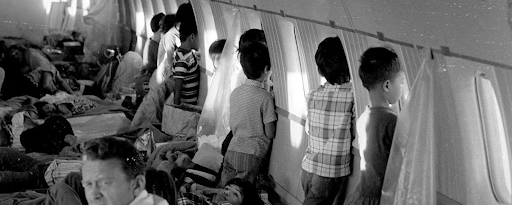
The USA government has already tried to solve the orphans problem. In April 1975, the government started an operation to repatriate those orphans using airplanes and helicopters. As a result, they saved more than 3,000 kids, but they lost hundreds of them when the aircraft C5A Galaxy fell with 400 kids and 60 volunteers and only 160 people survived.
At the same time that the operation was very successful in many aspects, it also caused enough horror for children to traumatize them. Many of these traumas were developed due to, for example, the helicopter sound. This operation became so poignant that authors have included it in recent books. In the book Broken Pieces, by Ann E. Burg, it is possible to see that, when the protagonist gets out of Vietnam, by helicopters and planes, the aircraft sounds leave some kids terrified, and even trigger panic attacks.
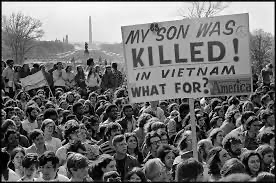
During all of these operations in Vietnam, the President John F. Kennedy acted for the indirect participation of the country in the war but, when he died, the new president Lyndon Johnson decided to intervene in the war, causing protests. These protests were open to anyone who wanted to participate, acting mostly against the war, racism, nuclear guns and in favor of women’s rights. This popular pressure of the war in Vietnam and the revolts occuring in the USA led the United States President Richard Nixon to propose a ceasefire with North Vietnamese troops, in 1973.
The book She Loves You, by Ann Hood, shows how music intervened in people’s lives during this difficult time, using it to escape from the war problems, through the point of view of a twelve-year-old girl called Trudy who lived in 1966 during the war. Her life was good until the war, then everything changed, and what really helped her deal with that difficult moment was precisely the music, more specifically the band The Beatles, that were really famous at the time.The band was really important for Trudy, helping her to distract herself and feel comfortable in her country during the hard times of her life by listening to music.
Trudy didn’t participate directly in the war, she did not fight on battlefields to really be considered a participant in that conflict but, even so, her life was impacted by the Vietnam War. Trudy lived part of her adolescence seeing the protests and revolts happen and having to deal with the conflicts in the school caused by the opinion and disagreement of the students in relation to the war.
Differently from Trudy’s story, the main character of the book Broken Pieces by Aan E. Burg worked directly in the conflict. In this book, readers follow a story of immigrants during the time of the war, and the relationships with their adoptive families, showing how some of the American people still mind Asian culture and how they welcomed the war orphans. The main character was an immigrant and suffered xenophobia for being Asian when he started living in the USA. He also suffered during the war, with the loss of his dad.
Like immigrants, soldiers at that time dealt directly with the war. The options at that time regarding military forces were voluntary or compulsory enlistment. these soldiers had to face this period of suffering whether they wanted to or not, and periods of war, especially for those who have lived it directly, became frightening and traumatizing, affecting the lives of many long-term.
The book Cracker! The best dog in Vietnam, by Cynthia Kadohata, shows the life of soldiers during the war, indicating the reader to perceive and understand different perspectives, fears, motivations and expectations of the people who were in that environment to defend their homeland, not only including the reality that soldiers dealt directly with the war by fighting in the conflicts , and also internally with the “fight” inside their minds. In addition, the book also shows the participation of dogs trained by the army to fight in battlefields, and the bond that soldiers develop with these animals during the war. The story specifically focuses on a female dog named Cracker, the soldier Rick Hanski, who she learns to live with amidst the chaos of war, and their relationship.
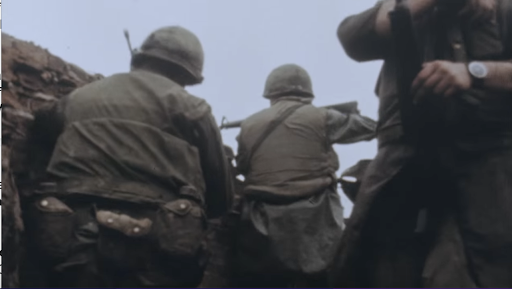
When Rick asked his family if he could sign up to become a soldier and fight in the Vietnam War, his grandfather’s expression turned grim. His grandfather (who had lived in Finland during World War II) described it as “an ugly thing,” “a horrible period of pain and suffering,” “a conflict that, no matter how many years pass, is still stuck in the mind of those who dealt with it. “For many of the US veterans who served in Vietnam, the psychological nightmare rages 40 years after the last Marine left Saigon. Psychological research suggests that as many as 271,000 war veterans may still have full-blown post-traumatic stress disorder, or PTSD. And for many vets, PTSD symptoms are only getting worse over time. “About 11% of Vietnam veterans over a 40-year period continue to suffer from clinically important PTSD symptoms, having either a full diagnosis or very strong diagnostic features that interfere with function,” says Charles Marmar, director of The Steven & Alexandra Cohen Veterans Center at NYU Langone Medical Center.
An interview conducted by Butsarakham Dyer, made questions to D.R.D: a veteran who fought in the Vietnam War and who preferred to have his identity withheld during the interview. The same said, in response to the question about his perceptions before and during the war: “Before, I was curious in a good but horrible way. Neither side could afford to lose a war. And so, I, who was previously interested academically and intellectually in the war, was horrified by what I saw happening. Without clear foreign policy goals, many battles were just people wandering in the mountains or jungles of Vietnam. And the body count was worth the metric. It was extremely common to receive questions like: How many Americans were killed this week? How many South Vietnamese were killed this weekend? How many North Vietnamese were killed this week? “
In addition to D.R.D’s claims of how horrible the war was and how many traumas and injuries he carries to this day, he says with conviction: “I don’t want to… I’m glad my son never left home for the purpose of being part of a draft. military, participate in a war. Well, I don’t want my grandson to go. I don’t want anyone else to go,” about his reaction to his son wanting to follow in the same footsteps as him.
In short, we can see that, in the midst of a war, different people deal with the conflict in different ways. Some try to find a mental refuge to forget the problems that surround them, such as the character Trudy, from the book She Loves You by Ann Hood, who, in the midst of the chaos of her country during the war, finds a mental escape in music. Otherswho deal more directly with war and want to escape that reality, such as immigrants, seek physical refuge elsewhere, in a place that is safe and free of fear, as in the book Broken Pieces by Aan E. Burg. There are also those who deal directly with the war out of obligation, like soldiers, who do not seek refuge, but a motivation to continue fighting without losing strength and to remain firm in that position, just like in the book named Cracker! The best dog in Vietnam by Cynthia Kohata.
War, one way or another, ends up affecting all people, in different or similar ways. As it is a difficult and frightening period, the war ends up triggering fears and psychological disorders even years later. Trying to have a refuge, whether mental or physical, is often not enough to preserve the human mind from the horrors that happen in a period of battle, and that makes us think: even if some people are part of the nation that emerged victorious from the Vietnam War, is victory equal to have sound mental health?
How have wars in Asia affected the kids who lived there
Authors: Renata Galvêas, Juliana Oliveira and Arthur Alvarenga
Asia’s history has been marked by multiple events that affected the continent’s organization, local people’s lives and Asian countries’ interaction. Japan, China, Pakistan, India and other countries were strongly affected by continent-wide conflicts such as The Second Sino-Japanese War (1937-1945) and the Kashmir War (1947-1949), and by great wars such as the Second World War (1939-1945). A relevant but infrequently approached discussion topic is how these combats have strongly affected kids over the years, how their lives have changed and how the effects were irreparable.
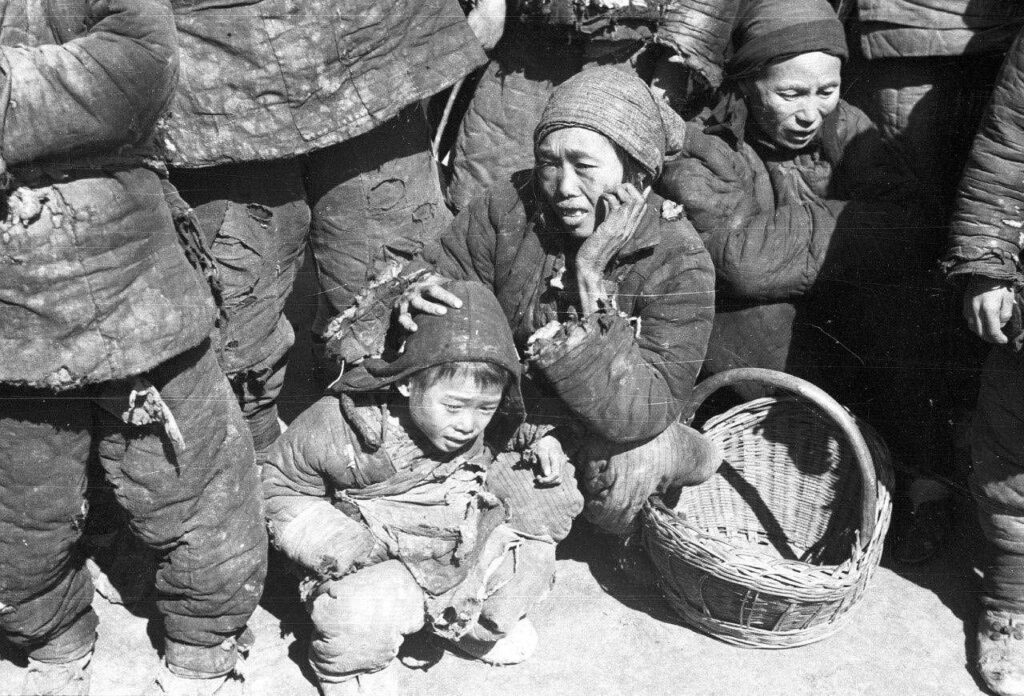
The Second Sino-Japanese War began in 1937 when China began large-scale resistance to the expanding Japanese influence on its territory from 1931. Historians estimate that between December 13, 1937, and late January 1938, Japanese forces killed or wounded an estimated 40,000 to 300,000 Chinese (mostly civilians) in the “Nanjing Massacre” (also known as the “Rape of Nanjing”) after its fall. In China, this conflict was called the War of Resistance against Japan, only in 1972 did the normalization of Sino-Japanese relations occur.
The book The Taste of Rain by Monique Polak is a historical fiction narrative based on that conflict. The main character and narrator, Gwen, had been separated from her parents who were missionaries and they had to leave northern China to work elsewhere, likewise in the real life that many of these children develop a strong attachment to the memories of their country and some to their absent parents, and some of them eventually acquired Japanese nationality.
Gwen’s city was mostly destroyed; the only good part of town was where the Japanese were, she was one of 140 children who were enrolled in a boarding school in Chefoo, China when the Imperial Japanese Army invaded the country and, for two and a half years, she was treated as a prisoner while her country was destroyed. Just as a study that was presented in (Eajs 2021) shows that people who were born in a Sino-Japanese relationship have many problems with identities, feeling of belonging to a certain country, and having response to various policies that were adopted in different post-war periods.In the book, one of Chefoo’s teachers named Miss E. helped Gwen and the other children to live through the war, treating her and her friends as if they were part of a Girl Guides troop. The Girl Guides promise not only to stay positive in the most challenging situations, but also to make good decisions, meaning that they should always be kind to others without any hope of getting a reward in return. This code helped them get through the conflict, making these moments of difficulty more joyful. However in real life some children of Chinese mothers and Japanese fathers born during the war looked to Japan as their true homeland for a long time. These children faced extreme social and political adversities as well as persistent questions of self-identity as well as persistent questions of self-identity.
Besides internal conflicts, Asia has also been through external conflicts. Historians agree that the most harmful and bloody combat has been the Second World War, which was aggravated by some discontent towards The Treaty of Versailles following WWI, the economic depression across the world and the rise of Nazism. Since the Second Sino-Japanese War, countries like Japan and China had a conflicting relationship, as each one was supporting a different side in WW2. Every citizen had their lives disturbed in irretrievable ways, but how were kids, specifically, affected by this conflict?
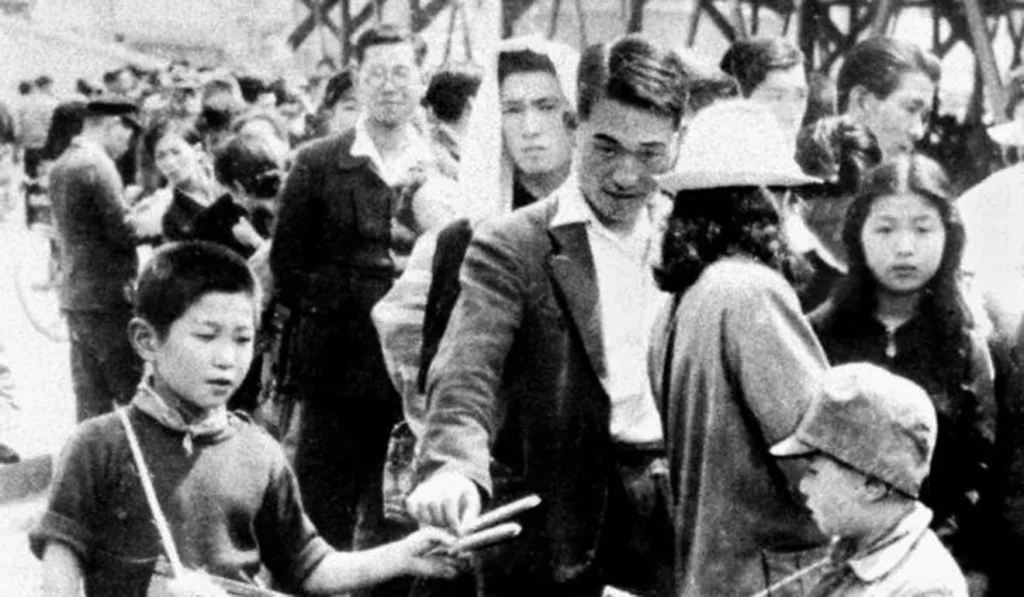
War orphans sell ice candy near Ueno station in Tokyo. (Young Post)
Imagine this: you are a Japanese kid during the war. Bomb alerts ring every single day at school. You see people around you going to war and never coming back, even though the Emperor says that Japan is winning. But you know it is not true. American CDs, hairstyles and clothes are being censored. And nobody really believes that something is going on. This is the situation of Yuriko-chan in the book The Last Cherry Blossomby Kathleen Burkinshaw. The book portrays World War 2 through the eyes of a kid in Hiroshima, 1944. A kid who is extensively sick of the war. A kid who realizes what is really happening and understands how they are not safe, not even at home.
Yuriko suffers with the war all throughout the book, even in small ways. The story starts by describing how it was to be at school while bomb alerts rang every day. It says that, after some time, kids got used to it, but not Yuriko. Every time a siren rang, the girl would hide under the chair and cover her ears until the sound was over, terrified of what could happen to her. In addition, Yuriko starts to realize how Japan is not winning when the remains of her neighbor Jiro-san come back after a couple of months of the war, or when Tokyo was bombed and she had to move to a house in the countryside. Also, it’s clear how Yuriko feels desperate and fearful because of the war when, on New Year’s Eve, the only thing she wishes for is peace.
The book title (The Last Cherry Blossom) is directly related to the theme of the text. When Yuriko has a deep conversation about Japan’s future with her dad, she asks him what would happen if they lost the war. Her papa answers that “I will keep my family safe at all costs… you are my life and I will give mine to save yours,” and she says she doesn’t want to be there without him. Then, papa finishes the conversation by mentioning a lesson, bringing up that this “is how life is, Yuriko-chan. In our lives, we must experience both beginnings as well as endings. It is like the season changing after the last cherry blossom falls.” At this moment it’s clear how the use of dialogue at that moment is essential to the understanding of how war affects different people in different ways. While Yuriko, as a kid, doesn’t want to even think about living without her dad, papa faces it differently: he sees life and death as part of a cycle. He uses a simile to compare the life cycle with the seasons changing, since it all brings new paths, opportunities and challenges.During war, kids experienced different situations that they had to adapt to in order to survive. As portrayed in The Last Cherry Blossom, kids’ daily routines had to be changed, since teaching children how to wear gas masks and implementing the ‘air raid drill’ into the school day became common. Even though these precautions shouldn’t be either experienced or of children’s concern, it was a necessity, not an option. To protect kids from bombings, air raid shelters were usually slept in by children. The not only physical but also mental harms it all has brought to those kids are unthinkable and irreparable. Gregory S. Johnson, a researcher from Otsuma University, Tokyo, Japan, says that “from the summer of 1944 to the autumn of 1945, Japan’s government evacuated over 400,000 urban primary school pupils. They were sent in the custody of their teachers to rural areas away from the increasing threat of air raids. The children lived and were schooled with classmates in Buddhist temples, inns, and other facilities. Officials couched the policy in terms of a training exercise, placating military and political opponents to the removal of children from their families. Furthermore, the government offered images of nurturing teachers as surrogate guardians to assuage parental concerns.” This shows how miserable the children’s conditions were and how the government was negligent because even though they said they just wanted to protect kids, the way they did it, by taking kids away from their parents and ignoring their reality after, showed that they didn’t really care.
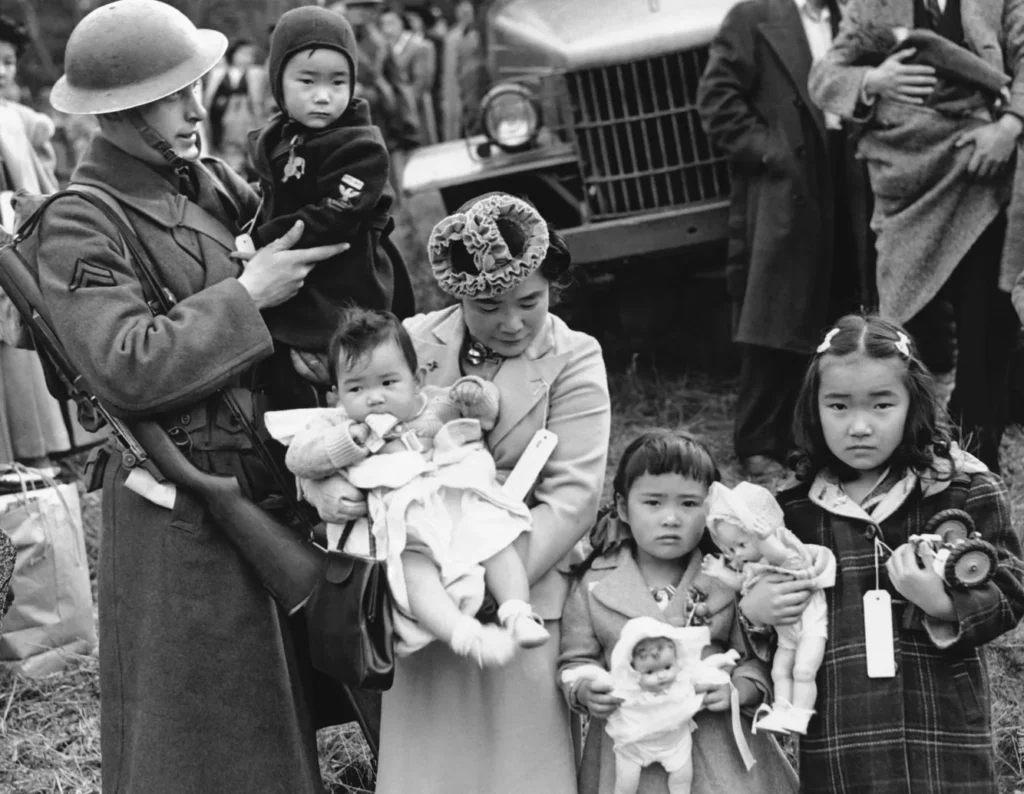
Shigeho Kitamoto and her children are forced to leave their home in 1942. (Seattle Times)
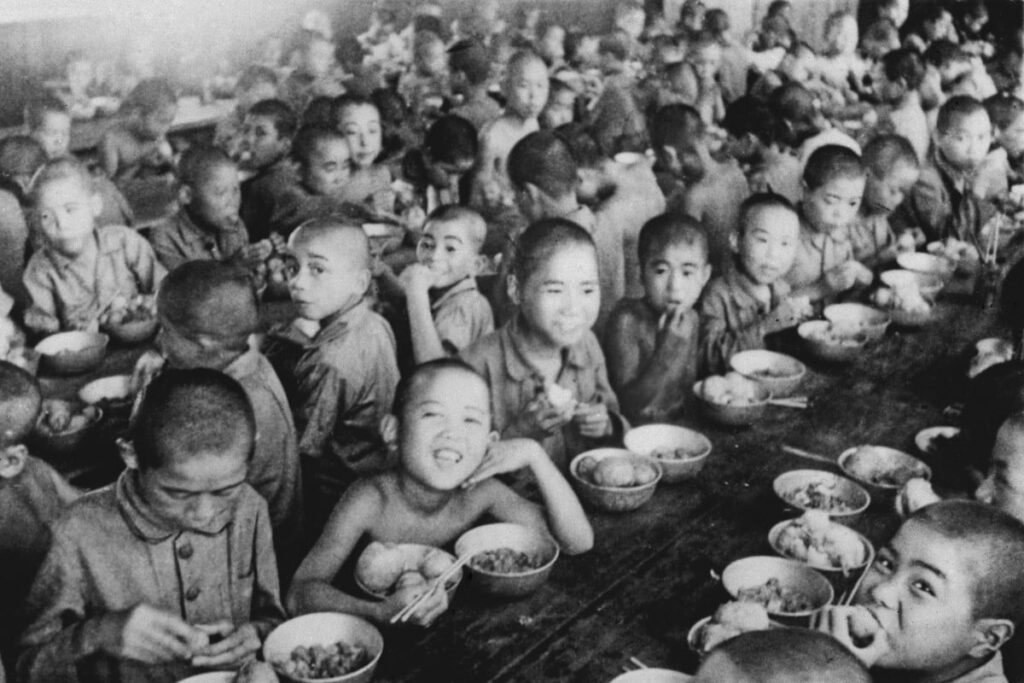
Samuel Yamashita, a Pomona College Professor of History, went deep on the topic and said “they were hungry, sick and poorly clothed and housed. They often were separated from their families and lost parents or siblings. Some lost their own lives.” He also mentioned the government’s negligence in this issue. The Young Post has also interviewed Japan’s Second World War orphans, who were kids at that time. They have reported that “for years, orphans in Japan were punished just for surviving the war. They were bullied. They were called trash and left to fend for themselves on the street. Police rounded them up and threw them in jail. They were sent to orphanages or sold for labor. They were abandoned by their government, abused, and discriminated against.” The harms of war were both mental and physical, and survivors who were kids at the time are still traumatized by these bloody and cruel conflicts that were not violent only to soldiers.
War orphans eat together at an orphanage in Tokyo in 1946. (Young Post)
Studies have also shown that the Second World War still has an impact on the growth pattern of Japanese children nowadays. The nutritional shock of rationing, food shortages and other health problems that Japanese people faced at that time still have an effect on the height of Asian kids. “At adulthood, Japanese boys and girls were 3.0 and 1.7 cm shorter than they would have been if the war had never occurred. The war also led to a delay in the pubertal growth spurt of about 0.5 years and slower maturation of children,” says scientist Eric Schneider, a researcher from the London School of Economics & Political Science. The studies suggest that teenagers and children in late childhood were the most affected by these hazards war has brought. It’s clear how younger people were the most affected. Besides all the struggles they have faced and all the pain they’ve suffered, the difficulties imposed have somehow modified their DNA, being visible and prejudicial until now.
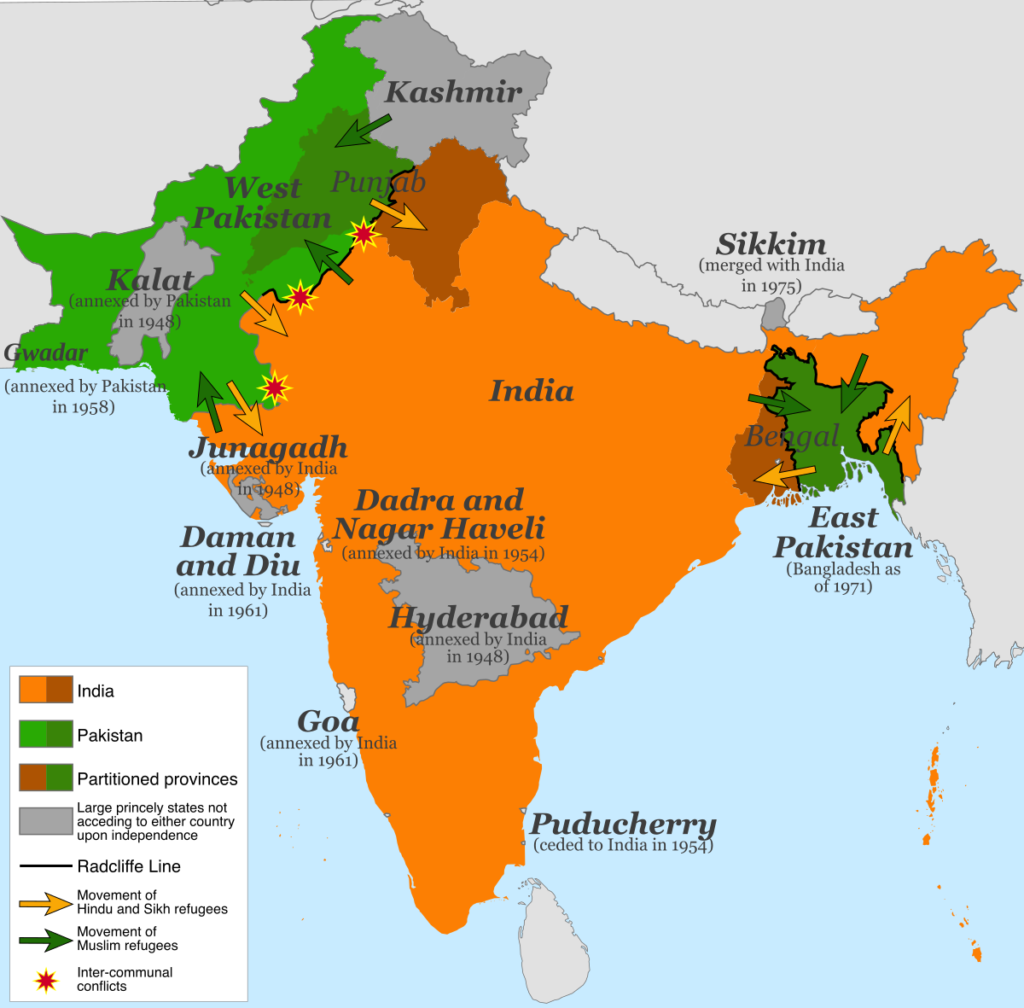
Another war that has marked the Asian continent is the First Kashmir War that began in 1947 and lasted until 1949, highlighting the impact of the division of the Indo-Pakistani territory. In this era the Pakistani and Indian interest about the Kashmir and Jammu estates increased for many reasons, such as water resources is available for human use, spanning the source of the Ganges and Indus rivers, the main rivers of India and Pakistan where some citizens of India’s cities perform Hindu rituals very significant to their religion, they believe that if you bathe in the waters of the river your soul will be purified by divine grace of Shiva and Ganga, gods. During this conflicting period, Hindu and Muslim people took advantage to further aggravate the disagreement they had, making firefights propitious. Besides all the direct conflicts, kidnapping of kids and teenagers were also happening with frequency in places next to the border between both Asian countries.
As globalization has taken over, more reports and evidence about war and conflicts, such as in the Asia region, have become much debated worldwide, making room for it within literature and cinema. In 2018, Veera Hiranandani published a book titled The Night Diary. The historical fiction book portrays many aspects of the Kashmir War, presenting some real facts, showing the reality of the old Indo-Pakistan population while creating a plot based on the fictional main character who is a girl named Nysha. She is just 12 years old and, to keep living in her house that is near the conflict zone, she has to deal with the constant worry of being attacked because of her family’s religion. In addition to the generalized context, the book also tells the kids’ perception about the war and how they suffer in this chaotic time, facing hunger and fear. The central theme of this book is identity added to religion and is observed as having the power to bring people together and also tear them apart. Although people have multiple identities, those ideas about who someone exists in a hierarchy where one identity is elevated above another.
Currently, Kashmir has its share region between India, Pakistan and China. India, in which the more practice religion is Hinduism, controls the part of Kashmir where the majority of the population is Muslim and seeks territorial independence or integration with Pakistan, adept to Islam. Despite the concrete territorial division, there are still reports of invasions and illegal immigration between these countries and of kidnappings often involving childrens from countries with religion opposite to those of the kidnappers, making evident the permanence of the feud between the countries of former Indo-Pakistan.
The great participation of the Asian continent in fight and internal or even external conflicts still cause a great impact, with children of the current generation suffering for the decision of their ancestors, being deprived of essential conditions for a human to live in a dignified way, such as food and a safe home to live. As the Pakistani activist Malala Yousafzai, a teenager that recognized the sad reality of her home country, would say, “the important thing is not the skin color, the language that is spoken, the religion that is practiced; the important thing is that we respect each other and consider we are all living beings.”
Authors: Enzo Monhol, Julia Nunes, Marina Andrade and Murilo Murad
Throughout African history, there has been a lot of suffering and exploitation of the African people and these countries were never economically rich as the first world countries. Influenza, the Sudanese Civil War, the Gulf War, and the Iran and Iraq War marked Africa’s history. Overall, these conflicts caused a huge number of deaths, since the government administration did not think about or prioritized the well-being of africans families, made questioning decisions and did not look at the quality of life and what Africans needed.
Influenza
When talking about pandemics in the world, mainly in Africa, it’s impossible not to mention the “Spanish flu,” the catastrophic outbreak of “Influenza.”After the First Great War in 1919, Africans thought that the deaths were over and now they would finally have peace without having to be victims of external conflicts. Even innocent families, kids and workers just wanted to continue with their lives. However, influenza came and infected 500 million people in different countries of the world, mainly in Africa, one of the continents where the disease came first.
At the end of the First Great War, Africans were surprised with influenza in their countries. The chaos came, and started to spread when ships transporting some of the 150,000 African troops who, together with 1.4 million laborers that provided logistics support to the war in Europe, brought Influenza to the seaports of Mombasa. The war, besides killing a lot of innocent people, played a significant role in transmitting the virus rapidly and globally. In the book Listening for Lions, by Gloria Whelan, the main character Rachel, is a African girl that came to England when she was a little kid, but in 1919, right when the Influenza epidemic started, she returned to Africa with 13 years old, because her parents were convocated to help the hospitals that did not have many doctors and good equipaments. Her parents were missionaries so when they came, the girl witnessed Influenza creating a terrible and painful situation for Africans, resulting in a number of families being broken by deaths. In the first chapter of the book, she says that just wanted to close her eyes and see again the beauty of Africa that was losing its people, its happiness and its colors, for the worrisome situation due to the virus. The girl had good memories of Africa in her childhood, and she hoped that this would not be erased from her mind. Raquel describes how influenza looks like through her point of view, and what she knew about diseases as a kid that did not understand the virus and never lived something like that; she says, “Father treated sleeping sickness, plague, smallpox, and leprosy” (p.6), suggesting the situation in Africa was so confuse, because no one knew what in fact the symptoms of influenza were.
Other countries, England, for instance, had to send missionaries to Africa to help decrease the level of the cases, and Raquel’s parents were one of them – her mother, as a teacher, also had to help her husband, who was different from the other doctors that were doing this job as a government order. Father looked at that as a mission with all africans families that did not have the fault of the bad government management with the influenza. Considering that Father and Mother were in the hospital for the whole day, it is no surprise that they got influenza and died. After that, Raquel decided to change her identity, as a plan to help Africa, pretending to be a girl from a local and very wealthy family. She was doing that because this family owned many plantations important to Africa’s economy, so considering the severity of the epidemic that was largely under colonial administration, the influence of rich people could make the government pay attention to the quality of hospitals, and the number of doctors after the loss of her parents. In the book, Raquel relates her plans to return to England and try to find more doctors asshe wouldn’t give up on the hard work that her parents did to Africa. This intensive job saved a great number of kids, mothers and also preserved families. Raquel learned with her parents that hospitals don’t mean death, because before the beginning of the epidemic Africans had the misconception that any person who goes to hospitals will die, since they were used to doctors not being properly trained. Her parents showed that hospitals can save people, because there are heroes like them.
The only data about deaths in Africa is that 2% of the country’s population is estimated to have died within 6 months, 2.5 million out of an estimated 130 million people. In the end of the book, Raquel felt frustrated and unable to help Africa in a way she expected. She would like to have built a large hospital with technological equipment and many doctors, a school for kids and a nursing school. The girl mentions, “I could not tell the government what to do or bring the rains” (p. 194), suggesting that the government didn’t want to look deeply at the real situation that Africans were living through and the chaos caused by that influenza epidemic. Moreover, many kids become orphans, since influenza used to kill young people. Africa was passing through these situations as a result mainly of the government that did not do what was necessary to protect Africans, and did not provide good hospital conditions to the population. From 1983 until 2005, in the Sudanese Civil War, women were raped and unable to provide food for their children, so the number of orphans grew wildly adding to the large number left by the influenza epidemic in 1919.
Sudanese Civil War
In 1983 the northern part of Sudan started a war against the south. This aggressive movement resulted from the north (and the government) wanting the whole country to follow Islamism. On the other hand there were different religious groups that didn’t want to be forced to follow only one. This led the south to fight for independence, with the objective to have their own independent concepts and ideas. After the North expose its goals and actively work to achieve them, there were consequences such as kids having to deal with war as adults, since their parents were killed for thinking differently from their former “allies,” and having to mature early to face this pain. Also, many women were raped and got pregnant, then they abandoned their children because they could’t supply their kids with food – a situation worsened by the tracks, such as hunger and sufferment influenza left in Africa; Many kids were lost in the war when they were sleeping since the adults left the children alone because they thought the kids would mess up more than help; and the North cut access to school in the South by destroying school buildings with government support.
The Comprehensive Peace Agreement, also known as the Treaty of Naivasha was signed in 2005 by Ali Osman Taha, the Vice President of Sudan and leader of the Sudan People’s Liberation Army (SPLA). It was a peace agreement which ended the Second Sudanese civil war. After almost three years of negotiation, the agreement ended the conflict of more than 21 years with approximately two million people dead and three million refugees and people displaced internally. In the agreement, it was established the formation of an interim government in Sudan by the National Congress Party (in power) and the Sudan People’s Liberation Movement (SPLM), with John Garang as first vice president, a six-year autonomy in the southern region (South Sudan), a referendum in 2011 (after the period of autonomy) with the possibility of the southern population trying for independence, a division of oil profits between the two parties, and amnesty for the guerrillas of the Sudan People’s Liberation Army.
In the book A Long Walk To Water by Linda Sue Park, the main character is a child living in 1983 Sudan. Salva (the main character) is abandoned by his refugee group when sleeping because he was a child, and his parents had been killed by northern troops that invaded his village. The ones that escaped, left him alone to die. Salva is alone in the middle of the completely devastated desert, fighting to survive, fighting against the temperature. “Why do they leave me without waking me? I would not have been any trouble-I would not have complained!… What will I do now?”(p.15)Salva is a portrayal of the kids that suffered in the war; he represents the fear, the pain, the hope, the innocence of a child… More than half of the kids that lived through what he faced didn’t survive. He also embodies the mindset of the kids that were killed in South Sudan, he represents Sudan’s people rights by showing how they were treated in this period of Sudan’s history.. The author tried to show in Salva how kids were feeling about the war, how they faced it, how the war impacted them, how traumatized they got. The northern region was so cruel that not only the children of the south were fighting, the government used children to conclude their plans, kids from the northern troops were also obligated to fight. This shows that kids were fighting against each other and not playing soccer, having fun.
Sudanese Second Civil War served to show what a man can do to others. people being dispatched because of their notion of what was right and wrong, orphan kids dying of hunger because of insufficient food. Parents were elimate or raped in front of them, the invader thought that if they witnessed this homicide they would feel afraid and follow thir order when grown up. This shows how this generation of kids were impacted by this war that lasted more than 20 years.
Gulf War and Iran – Iraq war
In 1991, a war happened between the United States and Iraq. This conflict occurred because Iraq invaded Kuwait to get more control of the lucrative oil supply of the Middle East. As an “answer”, the United States of America and the UN security Council demanded that the president of Iraq (Saddam Hussein) withdraw Iraq troops from Kuwait, but Hussein refused. As a consequence of refusal of the invasion of Iraq troops in Kuwait, the president of the United States (George Bush) attacked Iraq since they were also interested in the oil of Kuwait. That “new war” was called the gulf war, this conflict was named like that, because Kuwait is in the Gulf region. There were 148 American soldiers dead, and this war was the first war that was heavily televised.
Besides the Gulf War, the book Playing Atari with Saddam Hussein by Ali Fadhil and Jennifer Roy, also mentioned the Iran – Iraq war. This conflict was a result of border disputes, political and religious issues between the countriesIran and Iraq. This was a very violent conflict, responsable for 1 million of deaths total. The president of Iraq ( Saddam Hussein ) was a very violent president. As a consequence, we have these two wars ( Iran – Iraq in 1882 and Iraq – United States in 1991 ).
By these two wars, we could see similarities and differences between them. The 1882 war was not heavily televised as the 1991 was, in the Gulf War (the 1991 one ) had the United States as a winner, and in the Iran – Iraq war, nobody won. Both wars had a lot of people involved, but there was a big difference in the number of deaths between them. The United States – Iraq war had 600 thousand people killed and Iran – Iraq had 1,5 million people who died. The two wars were very bad for the Iraqi, because at the end of these conflicts the country entered into a severe economic crisis, which is very bad for the country.
Near the northern Kuwait-Iraq border, a Kuwaiti refugee family heads towards home on March 2, 1991 after being imprisoned in Iraq for a month during the war. AP Photo
Ali, an Iraqi boy, who is the main character of the book Playing Atari With Saddam Hussein, by Ali Fadhil and Jennifer Roy, is an Iraqi boy who is suffering because of the wars that his country entered in, sometimes he talks a little bit about the wars and his feelings. Most of the times he’s afraid and nervous, so when that situation of nervousness happens, he found a way to distract him, which is think that he was destroying a bomb from the United States in his mind, this somehow relax him from these tense situations. He has two brothers, Ahmed and Shizard, andhe also has a sister, Shireen, who isand she’s only six years old. His mother is responsible for the house, she’s always looking for help from her sons. Unlike his mother, Ali’s father is working all day, so he has little time to spend with his family. In conclusion, it can be observed that Ali is a boy who lives in Iraq, has a big family, and a short time to be together with his father, because he is working the whole day.
With these conflicts, Iraq entered a severe economic crisis, because they spent their money on armaments, security and war clothes, in addition to ending up not winning any of the wars, losing to the United States, a power at the time, and neither winning nor losing to Iran. In the Iran – Iraq war, both presidents Saddam Hussein from Iraq and Ruhollah Khomeini from Iran, the two were saying that their respective countries won the battle, but there was no winner.
The Iran – Iraq war
a war that left about 2 million dead
The Iran e Iraq war was a big conflict caused by politics , economics and religious disagreements. It happened in 1980, when started the military conflict between Iraq and Iran .In the iraq the president, Sadam Husseins was also a military dictatorship,
At that time The president used his army to advance along a broad front into Khūzestān, taking Iran by surprise. Iraq’s troops captured the city of Khorramshahr, but failed to take the important oil-refining center of Ābādān. In December of 1980 the Iraqi offensive had bogged down about 50–75 miles inside Iran, after meeting unexpectedly strong Iranian resistance.
The Islamic Revolutionary Guards Corps (IRGC) is an Iranian state military, initially tasked with safeguarding the Islamic Revolution .Their actions proved effective: a victory by the militia in April 1981 made the Iranian leadership to amplify its role in combat their enemies.
In August 1990, while Iraq was worried about its invasion of Kuwait (see Persian Gulf War), Iraq and Iran restored diplomatic relations, and Iraq agreed to Iranian terms for the settlement of the war.The Gulf War was a conflict in which Iraqi government action generated an international reaction. The two wars were bad for Iraqis, because the conflicts created a severe economic crisis.. Nowadays the country still suffers with the results of both wars , currently experiencing a major economic and social crisis.
In May 1982 Iranian forces recaptured Khorramshahr. Iraq voluntarily withdrew its forces from all captured Iranian territory, soon after and began seeking a peace agreement with Iran. But under the leadership of Ruhollah Khomeini who saw Saddam as an obstacle to the Islamic Revolution remained intransigent and continued the war in an effort to overthrow the Iraqi leader.
In July Iranian forces invaded Iraq’s Al-Baṣrah province. Iraq’s defenses solidified once its troops were defending their own soil,and the war settled down into a stalemate with a static, entrenched front running just inside and along Iraq’s border.
The lost boys
In 1982 a twelve years old boy named Reza had no interest in join iran force against Iraq. But when he knew that his uncle was dead he decided to join the war to take revenge on the people that started the war and put his uncle in a grave . His uncle was like a father to him , he was the only person in his family that supported him in his music career .His uncle never liked war but the government hunted him down until he joined. At that time The president used his army to advance along a broad front into Khūzestān, taking Iran by surprise. Iraq’s troops captured the city of Khorramshahr, but failed to take the important oil-refining center of Ābādān. In December of 1980 the Iraqi offensive had bogged down about 50–75 miles inside Iran, after meeting unexpectedly strong Iranian resistance.
The war had been one of the most destructive conflicts of the late 20th century. The total number of combatants on both sides is unclear, but both countries were fully mobilized, and most men of military age were under arms. The number of casualties was enormous but equally uncertain. Estimates of total casualties range from 1,000,000 to twice that number. The number killed on both sides was perhaps 500,000, with Iran suffering the greatest losses. It is estimated that between 50,000 and 100,000 Kurds were killed by Iraqi forces.
In conclusion this book talks about the things that happened in the war as a reality. In conclusion the war in general brings many sentimental losses and economic losses for countries, one example of that is iraq that suffers with the consequences of war so in general everyone will lose in war that’s why solving tinks with war is never the right way.
Fundado em 2022, este portal jornalístico vem como ferramenta de publicação de diversas produções textuais, em português e em inglês, dos estudantes da Escola Americana de Vitória.
Os textos aqui publicados não representam a opinião da EAV como instituição, mas sim a de cada autoria indicada.